The Oxus Auloi
Interpretation and reconstruction
DOI:
https://doi.org/10.1553/JMA-003-04Keywords:
Aulos, Takht-i Sangin, Ancient Bactria, Ancient Greek music, Music history, Greek modesAbstract
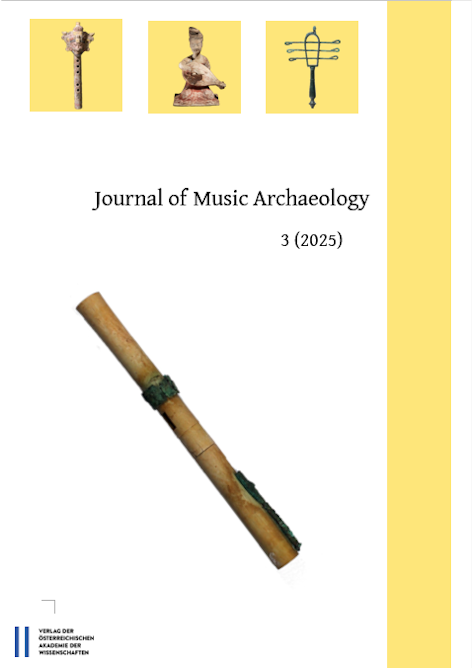
The aulos parts retrieved from the Oxus temple at Takht-i Sangin, Tajikistan, some of them fragmentary, are studied with respect to possible reconstructions of instruments or parts of instruments and the musical evaluation of these in the light of our knowledge of contemporary music. Even though half the material may be lost, recurring patterns indicate that some of the pipes followed a specific, obviously traditional design. Apart from these simpler instruments, others exhibit three different kinds of mechanisms for pitch adjustment, two of which have so far been undocumented. The predicted pitches are perfectly compatible with a late-Classical Greek musical system that had previously been reconstructed on the sole basis of textual evidence. The Oxus auloi thus form the first material evidence for one of the rivalling musical schools of the fourth century BCE.
Downloads
Published
Issue
Section
License
Copyright (c) 2025 the author

This work is licensed under a Creative Commons Attribution-NonCommercial-NoDerivatives 4.0 International License.